School Uniforms in Elementary School: 60.8% of Parents Support the Idea
Key Summary
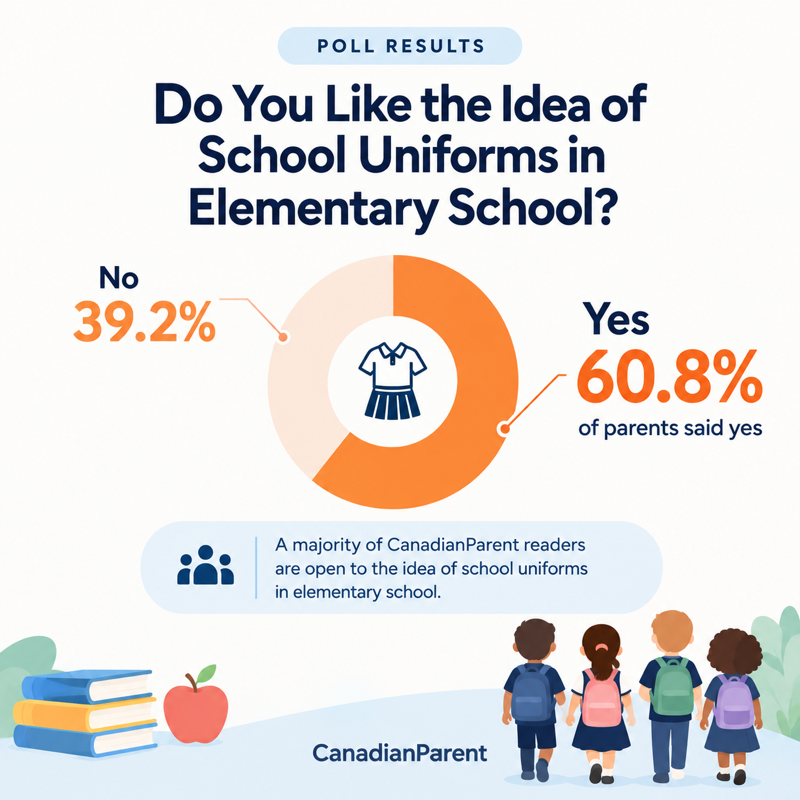
We asked CanadianParent readers whether they like the idea of school uniforms in elementary school. Of the 7,290 respondents, 60.8% said yes, suggesting that a majority of participating readers are open to introducing uniforms during the elementary years.
Supporters often point to simpler morning routines, fewer clothing-related comparisons and a stronger sense of school identity. However, questions about affordability, comfort, self-expression and whether uniforms actually improve educational outcomes remain part of the debate.
Key findings:
- 60.8% of respondents said yes to the idea of school uniforms in elementary school.
- 39.2% said no.
- The poll received 7,290 responses from CanadianParent members.
- Potential benefits include simplified school-morning routines and less pressure around clothing choices.
- Critics raise concerns about additional costs, comfort, individuality and the freedom to choose what children wear.
- Research has not established that school uniforms alone reliably improve academic achievement or student behaviour.
Are School Uniforms a Good Idea for Elementary Students?
From choosing outfits before school to navigating clothing trends and peer comparisons, what children wear can become an everyday parenting consideration.
For some families, school uniforms offer a practical solution. A standard dress code can make getting ready easier, reduce disagreements over clothing and give students a shared visual identity. For others, allowing children to choose their own outfits is an important opportunity to develop independence and express their personalities.
To find out where parents stand, CanadianParent asked readers whether they like the idea of school uniforms in elementary school.
The results suggest that support is relatively strong: 60.8% of respondents voted yes, while 39.2% voted no.
While the result does not necessarily mean every supporter wants a strict, formal uniform policy, it indicates that the idea resonates with a majority of the readers who participated.
Why Some Parents Support School Uniforms
1. Easier school-morning routines
Getting young children dressed and out the door can be a daily challenge. Uniforms may simplify the process by reducing the number of clothing decisions families need to make before school.
Having a predictable set of school clothes can also help children practise getting dressed independently and establish a consistent morning routine.
2. Less pressure around clothing and brands
As children become more aware of what their classmates wear, clothing can sometimes become a source of comparison. Uniforms may help reduce the visibility of brand names, fashion trends and differences in everyday outfits.
However, uniforms cannot eliminate socioeconomic differences entirely, and the impact depends on how a school implements its policy.
3. A shared sense of school identity
Some parents and educators believe uniforms help foster a sense of belonging by giving students a common visual identity. Uniforms can also make school dress expectations easier to communicate.
Whether this translates into stronger relationships or a greater sense of belonging, however, depends on the wider school environment rather than clothing alone.
Why Other Families Prefer Regular Clothes
1. Children need opportunities for self-expression
Choosing an outfit can be a simple way for young children to explore their preferences and develop independence. Families who oppose uniforms may feel that elementary school is an important time for children to learn to make age-appropriate choices.
2. Uniforms can add to family expenses
Uniforms may require parents to purchase specific items in addition to their children’s regular wardrobes. This can become an added expense as children grow quickly and need replacement clothing.
The cost depends on the policy: a requirement for a particular branded outfit may be more expensive than a flexible dress code that allows inexpensive, widely available basics.
3. Comfort, accessibility and inclusion matter
Children need clothing that suits their activities, bodies, sensory preferences and individual circumstances. A uniform policy that is too restrictive may create unnecessary difficulties for some students.
Flexible options, including a choice of garments and accommodations for religious, cultural, medical or accessibility needs, can help make policies more inclusive.
What Does the Research Say About School Uniforms?
Although uniforms are often promoted as a way to improve discipline, behaviour and academic performance, the research is more mixed than popular perceptions might suggest.
A study published in Early Childhood Research Quarterly examined data from 6,320 students in the United States. Researchers found that students attending schools with uniform requirements generally did not demonstrate better social-behavioural outcomes or attendance than students at schools without uniform requirements. There was some indication of improved attendance among lower-income students in schools with uniforms.
A separate review published in Public Health Reviews examined the educational, physical and psychological implications of school uniforms. It concluded that there was little convincing evidence that uniforms directly improve academic performance, while highlighting the importance of garment design, student well-being, equity and inclusion.
These findings do not mean uniforms cannot be useful. They suggest that uniforms should not be treated as a guaranteed solution to academic or behavioural challenges. Their value may depend more on affordability, comfort, flexibility and the goals of an individual school community.
For elementary students in particular, a thoughtful policy should consider both practical benefits for families and the needs of children as they learn, play and develop their identities.
Expert Commentary
School uniforms are often presented as a straightforward solution to challenges such as clothing-related peer pressure and difficult morning routines. However, their effectiveness depends on how policies are designed and implemented.
The CanadianParent poll suggests that many participating readers are receptive to the idea. The research also highlights the importance of looking beyond the uniform itself: an inclusive school culture, accessible clothing options and reasonable costs matter when evaluating whether a policy benefits students.
The question for schools may not simply be whether uniforms should be required, but how any dress policy can balance practicality, affordability, comfort and student individuality.
What This Poll Tells Us About Canadian Parents
With 60.8% of respondents supporting the idea of elementary school uniforms, the poll points to majority support among participating CanadianParent readers.
Still, a yes-or-no poll cannot tell us why respondents voted as they did, whether they favour mandatory uniforms or a more flexible dress code, or whether their views differ based on their children’s ages or school experiences.
Further polling could explore these questions, including whether parents would support uniforms if schools offered financial assistance, allowed multiple clothing options or used a simple dress code rather than a prescribed uniform.
For now, the results offer a useful snapshot of readers’ attitudes toward an ongoing education debate.
Final Thoughts
School uniforms remain a topic where convenience, school identity and concerns about individuality intersect. The CanadianParent poll suggests that the idea appeals to a majority of participating readers, but support for uniforms does not necessarily mean support for a strict or expensive policy.
Ultimately, schools considering uniforms must weigh the practical benefits against the needs of students and families. Affordable options, comfortable clothing and flexibility may be just as important as the decision to introduce a uniform in the first place.
Methodology
This article is based on responses to the CanadianParent poll, “Do you like the idea of school uniforms in elementary school?”
- Audience: 7,290 CanadianParent members who participated in the on-site poll.
- Poll period: The poll opened on August 27, 2026. Results reflect responses received as of October 2026.
- Response options: Yes or No.
- Reported result: 60.8% answered yes and 39.2% answered no.
- Data source: CanadianParent.ca poll results.
- Important limitation: The results represent participating readers and should not be interpreted as a nationally representative survey of all Canadian parents.
Relevant Resources
- School Uniforms and Student Behavior: Is There a Link? Research examining uniforms and elementary students’ behaviour, social skills and attendance. Read the study in Early Childhood Research Quarterly
- Reviewing School Uniform through a Public Health Lens: A review of research on uniforms, student well-being, equity and educational outcomes. Read the review in Public Health Reviews
- Education Endowment Foundation – School Uniform: An overview of the evidence on school uniforms and educational outcomes. EEF Teaching and Learning Toolkit: School Uniform
Cite This Study
CanadianParent.ca (2026). School Uniforms in Elementary School: 60.8% of Parents Support the Idea. CanadianParent Poll, 7,290 respondents. Available at: https://ca.jqd.io/rewards/poll/do-you-like-the-idea-of-school-uniforms-in-elementary-school
More Like This
Explore more CanadianParent polls about parenting, education and family life.